
Customer
End users identified by the SDK who appear in Customers and analytics.
Purpose
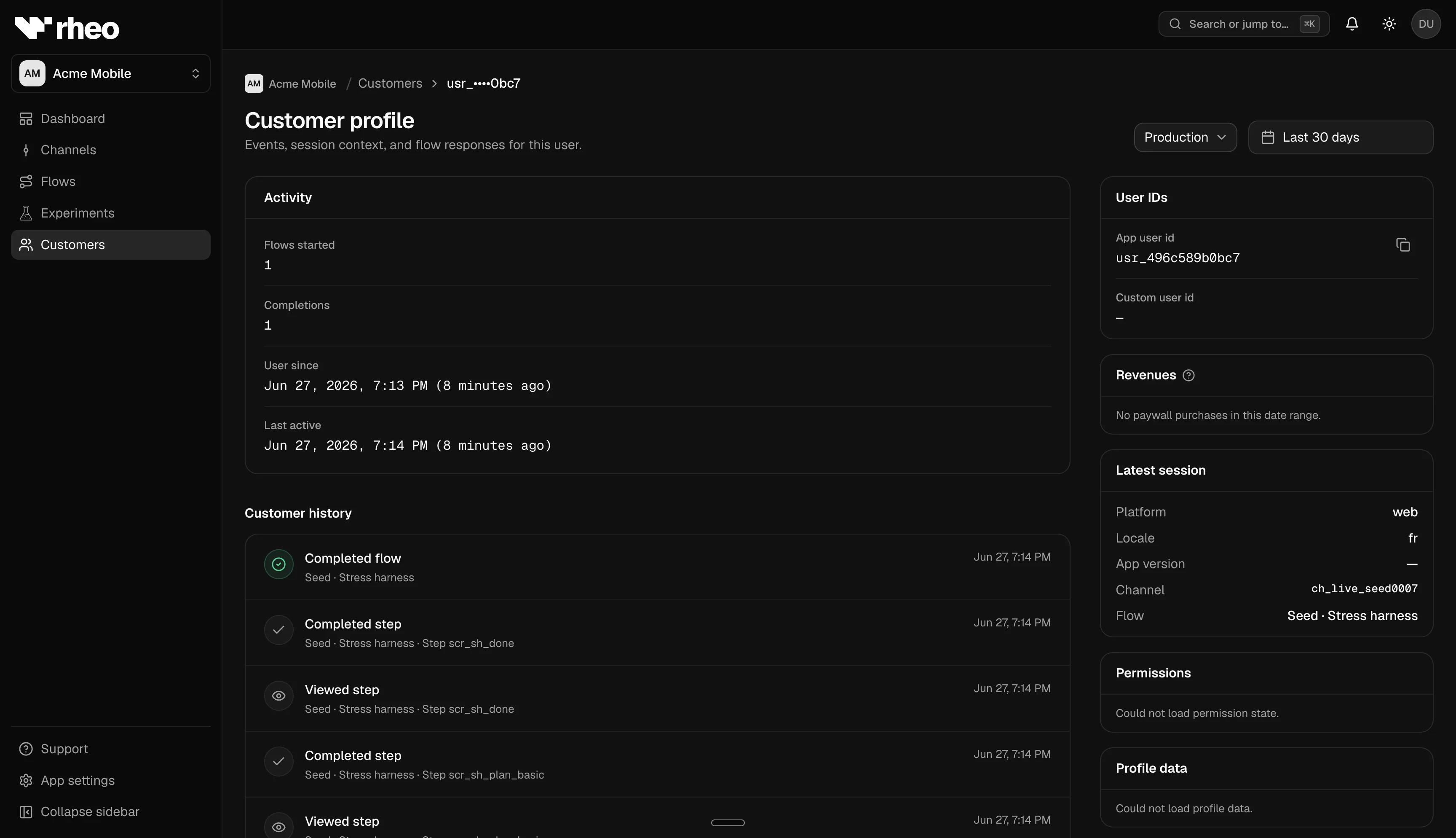
A customer is an end user of your mobile app: the single person entity for SDK identity (appUserId), optional email, and email marketing consent. The dashboard Customers section lists these people (including email-only imports) and shows per-user event timelines when SDK activity exists.
Customers are not synthetic dashboard personas or a separate “email contact” noun.
Dashboard surfaces
| Area | What you see |
|---|---|
| Customers (app sidebar) | Directory with environment, date, and consent filters |
| Customer profile | Timeline, variables, permissions, revenue, and marketing consent |
Use customer profiles to debug individual journeys, verify experiment assignment, manage marketing consent, or support users who report onboarding issues.
How identity works
Your app provides identity when initializing the SDK:
- User ID (required) — Primary analytics key and experiment bucketing input. Use a stable ID that persists across sessions (for example your auth user ID or a generated anonymous ID).
- Custom user ID (optional) — Your CRM or backend user ID, set at runtime if it differs from the primary ID.
- Session ID (optional) — Per-launch session for flow funnel analysis.
- Identify — When you collect email (and marketing consent) in the app, call SDK
identifyso Rheo stores email + consent on the same customer. Do not rely on email event traits for marketing opt-in.
CSV import without app_user_id creates a customer with a Rheo-minted id that can later merge when the SDK identifies the same email.
Related
- Customers — List, profile, timeline, and variables.
- Rheo Engage — Lifecycle email that respects marketing consent on this Customer.
- Customers & analytics — Flow-level funnels and cohort charts.
- SDK environment — Test vs live scope in the dashboard.